
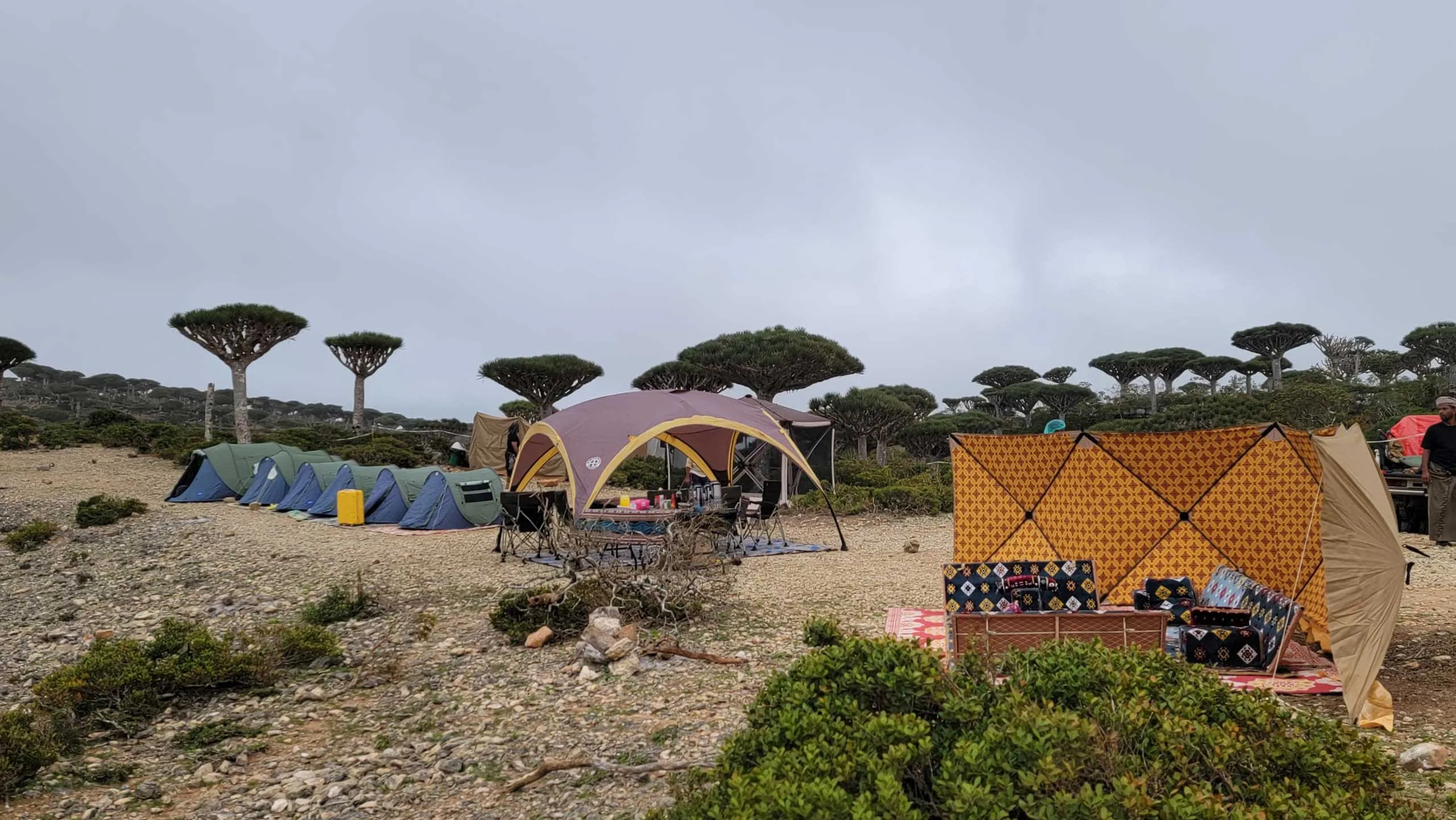
Few living things look quite as otherworldly as Dracaena cinnabari, the legendary dragon’s blood tree of Yemen’s Socotra Archipelago. Found only across the island’s high plateaus, it is far more than an exotic, photogenic curiosity. The tree is an engineering marvel of specialized hydrology and a longstanding anchor of local cultural heritage.

Evolutionary Architecture: Creating Life From Fog
Socotra is a harsh, dry environment of sun-baked limestone with little seasonal rain. The umbrella-like silhouette of the Dragon’s Blood Tree didn’t evolve for aesthetic drama, it evolved to harvest moisture where rain fails to fall.
- Atmospheric cloud interception, the high Dixam and Firmihin plateaus frequently loom above the marine layer in a bed of sea-fog and cloudy mists.
- The tree’s rigid, densely arranged rosettes of leaves act as atmospheric collectors. Axial Stemflow Any mist collecting on these leaves isn’t broadcast outwards where equatorial winds and heat will cause it to immediately evaporate but is instead directed downwards internally, along the leaf axis down to branch nodes, ultimately flowing down towards the Tree’s central trunk.
- Beneath the under-canopy microclimates, the Tree’s compact canopies cast broad, unwavering shadows on to its roots, limiting the amount of evaporation from the soil surface, locking in soil humidity, and offering fertile microclimates where small plants and young Trees can thrive protected from the direct sun.

The Dam al-Akhawain (The Legend and Uses of the Blood Resin)
When the bark is nicked and gashed on the tree, a treacle-thick resin the colour of dark garnets emerges; known locally as “The Blood of the Two Brothers” (Dam al-Akhawain) in Arabic, and Emzoloh in the non-written native dialect of Soqotra-the resin possesses a folklife of thousands of years behind its extensive uses.
The local legend connects the red sap to an ancient battle, presumably fought on Socotra between the traditional ‘Cain and Abel’ figures (or some local mythic king-figures) the two brothers, and their blood seeping into the ground led to the emergence of the first trees. The Greeks, Romans, Arabs and Indians each had their trade networks, and would happily fork out cash for “cinnabar resin cakes” being shipped along the Indian Ocean.

Ecological Vulnerability: The Lifespan – the “Century Long Bottleneck”
While being to weather for the last 60 odd million years, alone for millions of years sinceSocotra broke offthe then super Gondwanacontinent, there are now a number of immediate system pressures on the cinnabar’s trees.
- Demographic collapse the trees don’t have readily identifiable annual rings, but dendrochronological data places aged ones several hundreds of years old with inch-of-an-inch, growth rings per year, at best.
- Overgrazing centuries of widespread pastoral land utilization has further exacerbation the grazing of free roaming goats on young trees. Trees take about a decade and half to reach above the so-called “grazing line”, meaning that without intervention, just about every naturally occurring tree gets eaten before it matures.
- Growing cyclones shift in Indian ocean cyclone routes have driven the more severe “Category 3” and “Category 4” cycles, like Chapala and Megh, in historic proportions-rippling across the island and taking out hundreds of top-heavy mature trees in a single swell.

The Road Ahead: Regeneration and Stewardship
The key to saving the Dragon’s Blood Tree lies in grassroots, community-based efforts. Sheltered, stone-walled villages in Dixam Plateau and protected areas such as Homhil are protecting growing nurseries from livestock, raising immature saplings into young trees for about a decade. Tourists, visitors, photographers all need to be mindful of the protective fencing in these regeneration areas, keep to the well established paths (to avoid compacting the soil around young roots) and contribute to grassrootsnative efforts that keep the ancient umbrellas up!